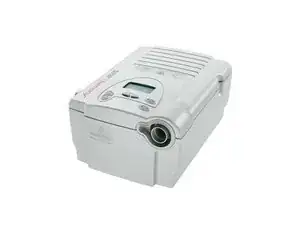

Respironics BiPAP Harmony - User Guide
Background:
The BiPAP Harmony is a low-pressure, electronically driven ventilator system with electronic pressure control.The device’s pressure controls are adjusted to deliver pressure support for patient ventilatory assistance.The BiPAP Harmony is intended to augment patient breathing by supplying pressurized air through a patient circuit. It senses the patient’s breathing effort by monitoring airflow in the patient circuit and adjusts its output to assist in inhalation and exhalation. This assistance is provided by the administration of two levels of positive pressure. During exhalation, pressure is variably positive or near ambient. During inspiration, pressure is variably positive and always equal to or higher than the expiratory level. While the exact date of release for the BiPAP Harmony is 2008 by Philips but it has been introduced during 1990s as BiPAP technology.
In the Continuous Positive Airway Pressure (CPAP) mode, the BiPAPHarmony delivers continuous pressure support ventilation at one pressure level.In the Spontaneous (S) mode, the BiPAP Harmony delivers bi-level pressure support. The device triggers to Inspiratory Positive AirwayPressure (IPAP) in response to spontaneous inspiratory effort and cycles to Expiratory Positive Airway Pressure (EPAP) during exhalation.The level of pressure support (PS) delivered is determined by the difference between the IPAP and EPAP settings (PS=IPAP-EPAP).The Spontaneous/Timed (S/T) mode of the BiPAP Harmony is similar to the S mode, except that it also can deliver a machine-triggered breath if the patient does not spontaneously breathe within a set time.
- BI-FLEX COMFORT FEATUREThe BiPAP Harmony includes a special comfort feature called Bi-Flex.This feature is provided in S mode. The Bi-Flex attribute adjusts therapy by inserting a small amount of pressure relief during the latter stages of inspiration and during active exhalation (the beginning part of exhalation). Bi-Flex levels 1, 2, and 3 progressively increase pressure relief.
- RAMP FEATUREBiPAP Harmony is equipped with a linear ramp function. The ramp feature will reduce the pressure and then gradually increase (ramp) the pressure to the prescription pressure setting so patients can fall a sleep more comfortably.
- DIGITAL AUTO-TRAK SENSITIVITYAn important characteristic of the BiPAP Harmony is its ability to recognize and compensate for unintentional leaks in the system and to automatically adjust its trigger and cycle algorithms to maintain optimum performance in the presence of leaks. This feature is known as Digital Auto-Trak Sensitivity.
- LEAK TO LERAN CEA microprocessor monitors the total flow of the patient circuit and calculates patient flow values. The BiPAP Harmony uses two leak estimation algorithms. A conservation of mass algorithm is used to
* POWER FAIL CIRCUITRYWhen power is removed from the unit, but the on/off button remains in the on position, the unit will enter power fail mode. Voltage is held up by C57. This voltage is boosted and regulated by U15 to provide a fixed loudness. As the capacitor drains, Q26 and Q25 with the surrounding circuitry provide an astable vibrator to provide a 2 second on / 2 second off buzzer. The red LED remains on continuously. Power fail on the board is detected by the existence or lack of +5 Volts.
Features:
- AC Power Connector: AC power supply connection.
- Air Outlet PortFlexible tubing/patient circuit connection.
- DC Power ConnectorOptional DC power connection.
- AC Power IndicatorLED Display for AC power.
- DC Power IndicatorLED Display for DC power.
- High Priority Alarm IndicatorLED Display for High Priority Alarms.
- RED Low/Medium Priority Alarm IndicatorLED Display for Low/Medium Priority Alarms
- YELLOW Display ScreenLiquid Crystal Display where all device settings appear.
- Pressure On/OffStarts or stops the devices airflow.
- HeatControls the optional Heated Humidifier.
- RampLowers the airflow pressure allowing the patient to fall asleep more easily.
SPECIFICATIONS, FEATURES, DESCRIPTIONS, AND THE ORYOF OPERATION 3-7BIPAP® HARMONY® SERVICE MANUAL REV.
1022085compute the average leak for a given pressure support relationship.This average leak is a high estimate during EPAP pressure and a low estimate during IPAP pressure
THEORY OF OPERATION
MAIN PRINTED CIRCUIT ASSEMBLY (PCA)The Main PCA is the computer control center of the BiPAP Harmony. Amicro controller reads and writes to various I/O devices such as the control pad, LCD, memory chips, pressure and flow sensors and motor control circuitry. The microcontroller will make appropriate adjustments to the valve and blower using this information to deliver the desired therapy to the patient.
POWER DISTRIBUTION: There are two 3 pin power din connectors on the back of the BiPAPHarmony. They will except the bulk voltage on pin 1 from either an external AC/DC 60W Respironics’ power supply or an external DC/DC Respironics’ power supply with the mating connector.
Pin 2 is there turn on both connectors. Pin 3 is a multi-purpose pin. It is floating when the AC/DC converter is connected. It is connected to the battery voltage to read on internal ADC channel 0. When the AC/DC converter is used, the bulk voltage will range from 24 to 28 VDC.
Identification:
This device can be identified by the integrated LCD screen, dual 3 pin power DIN connector and compact design of it. Also it should be checked by the label which is underside of the device that contains the serial number and model number which should match the Harmony BiPAP model.
SPECIFICATIONS, FEATURES, DESCRIPTIONS, AND THE ORYOF OPERATION 3-8BIPAP® HARMONY® SERVICE MANUAL REV. 1022085ADC channel 4). When the DC/DC converter is used, the voltage will be less than 23.
5 VOLT SWITCHING POWER SUPPLY5 Volts is needed throughout the main PCA for logic circuits. U16 is a simple switcher which produces a 5V output from the bulk voltage. The input cap, C45, is oversized and serves both as an input filter for the bulk voltage at the input connector and the high frequency input cap for this switcher. The output cap, C79, maintains the output ripple voltage below 50 mV. L2 allows 2A output currents comfortably due to its size.
+12V REGULATOR U18 produces the 12 Volts needed to bias the flow sensor and it is also used as the positive rail for the analog circuitry and the operational amplifiers of the valve controller.
-12V SWITCHING CIRC UITA negative power supply is created by using an output from the microcontroller switching current through resistor R186 and capacitorC80. This negative voltage is used as the negative rail for the analog circuitry and valve controller operational amplifiers.
+3.3V REGULATOR:The core and I/O of the microcontroller are driven by 3.3 volts. Voltage regulator U12 creates this voltage from the 5V power supply.
Technical Specification:
BiPAP Harmony should include the following items:
- BiPAP Harmony with Encore Pro SmartCard
- Filter cap
- power cord
- pollen filters
- ultrafine filters
- Flexible Tubing 6 ft. (1.83 m) X 22 mm i.d
- Flexible Tubing
- 6 ft. (1.83 m) X 22 mm i.d
Additional Information:
Here is some online sources which also can help with the guide and device more detail: